
The Mastery of Leadership:
Presence and Practice in Transformational Change
Master the art of transformational leadership: The Mastery of Leadership brings together the tangible and intangible dimensions each so vital to success – and yet so rarely brought together – and enables you to bring out the best in other people in a sustainable way.
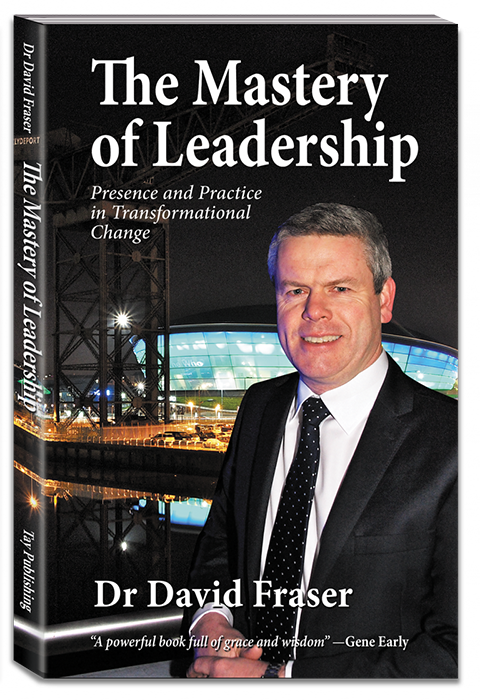
In this bold and thought-provoking book, experienced change agent Dr David Fraser provides profound, actionable insights into how to:
- Lead in an enlightened way
- Handle ambiguity with grace
- Inspire success in other people
- Be influential even without authority
- Shape the future of an organisation
- Be peaceful, effective, and resilient
Reviews
Order your copy now
Purchase The Mastery of Leadership from Amazon.co.uk
Also available from Amazon.com, BarnesandNoble.com and Amazon.ca
274 pages, ISBN 13: 978-0-9932491-0-5
Cover price £12.99 UK $15.99 USA (or equivalent in other currency)
FAQs
Your Title Goes Here
Your content goes here. Edit or remove this text inline or in the module Content settings. You can also style every aspect of this content in the module Design settings and even apply custom CSS to this text in the module Advanced settings.
Can anyone be a leader?
Many more people than we perhaps think can be leaders. It depends on whether they have or develop the emotional commitment to achieve a desired outcome. Sometimes, that passion can appear in unexpected places and being open to the possibility is very important. Leaders may not necessarily be found among the managers. Put very simply, if they care enough, they can probably be a leader.
What is your approach to developing leaders?
I believe in working with a defined set of competences in mind. That provides possibilities for self-assessment. The model I recommend has 19 elements in 5 groupings and has a very strong provenance across organisations and sectors. Much of learning to lead other people begins with leading oneself well and we generally start there. Various settings for learning can be employed: group workshops (in-person), individual coaching, and on-line workshops with fellow participants in similar roles in other companies.
How long does it take to develop a leader?
6 months is really the minimum time to make a serious difference to someone’s leadership ability. 1-2 years is more realistic for a completed transformation. Of course, learning about leadership never finishes as circumstances change and new responsibilities are taken on. I have been retained to develop leaders in organisations over decades. After time, institutional knowledge becomes helpful too.
How is leadership different in industry and academia?
The principles are essentially the same. In academia, however, there is typically less ability to direct or instruct staff – certainly academic staff – and so the ability to influence with effective leadership skills is all the more important. Essentially, in industry, it may be possible to tell people to do things with some chance of success (though that isn’t the best way, usually); in academia, you can’t really do that. Professional services in universities are more like industry in that respect. Everywhere, it’s better in the long run to get people to do things through persuasion and inspiration even if you do have the authority to just instruct them.
What exactly do you mean by “enterprising” and why do you use that word?
I mean enterprising in the sense of “having or showing initiative and resourcefulness” (Oxford dictionary) or being “good at thinking of and doing new and difficult things, especially things that will make money” (Cambridge dictionary). The first definition is particularly apposite. I strongly believe in the value of leadership that is taking the initiative and getting on and doing whatever needs to be done – being “on it”. The unifying theme of my work is getting more of that happening.
How much of the job of developing leaders do you take on?
My involvement can range from just some assistance to the senior leader in developing an internal approach through to taking most of the responsibility for the growth of the leadership group. Quite commonly, senior leaders want to be able to task their leaders with what needs done and have someone else take care of the development of the individuals involved. Developing other people is one of the pleasures of a senior role, but unfortunately, real life doesn’t always allow enough time and it’s wise to bring in some assistance. That also means a broadly-based, rounded approach is employed – one that will prepare your leaders for future challenges, not just the issues of the present day.
What specific expertise do you bring to this?
I have had leadership responsibilities up to board level in a number of businesses and have worked with leaders in more than 180 organisations. I’ve also researched a comprehensive set of tools and techniques to bring a structured approach to leadership and organisational development. I’ve written two books on the subject.
Can your online workshop groups be joined at any time?
Yes. The Strategic Leaders and Stepping Up to Leadership groups continue indefinitely and are open to new members at any time. Please get in touch if you’d like to know more or to apply to join.